Central computers are transforming data acquisition in vehicles
With zonal E/E architectures, it is not only the distribution of computing power within the vehicle that is changing. A fresh look must be taken at where development-relevant data is generated and how it can be made accessible for analysis and validation.
Whilst traditional vehicle architectures are characterised by distributed control units and communication via bus systems, zone controllers are increasingly taking on the task of aggregating sensor and bus data. The actual processing then takes place on a small number of central high-performance computers. This is where, for example, results from sensor fusion, environmental models or internal intermediate states are generated. A significant portion of this data exists exclusively in the central computer’s memory.
This presents a new challenge for measurement and validation systems: whilst relevant data is available, it is not necessarily transmitted via an external communication interface.
This architectural shift suggests a different approach: rather than first sending data out of the control unit via additional software, it can be captured where it is already available – in the central computer’s RAM.
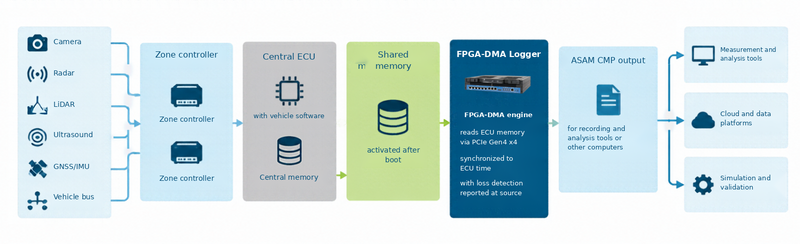
PCI Express (PCIe) offers one possibility for this. The technology allows direct access to predefined memory areas of the computer. After the system starts up, the ECU releases the relevant areas once. An external measurement system can then access this data via Direct Memory Access (DMA). The actual vehicle software therefore does not need to actively transmit the measurement data continuously.
The technical principle can be illustrated as follows:
An FPGA-based DMA engine reads the released memory areas via PCIe. During acquisition, the data blocks can be assigned a common measurement time base, correlated with the ECU time and monitored for transmission losses using ‘ ’. In the concept described, the subsequent output takes place via ASAM CMP.
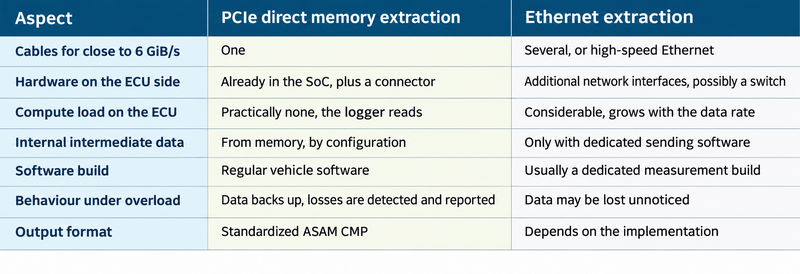
A key advantage of this data acquisition method is the available bandwidth. In the configuration described, data rates of around 51.5 Gbit/s are possible via a single PCIe Gen 4 x4 connection. The achievable bandwidth naturally scales with the PCIe generation and the number of PCIe lanes used.
However, it is not just the speed that is of technological interest. With previous Ethernet-based data extraction methods, internal data must first be read from memory by software, processed and then transmitted via the communication interface. This requires additional computing capacity, interface resources and a corresponding software implementation. Furthermore, for data that exists solely as internal intermediate results, explicit provision by the measurement software is required.
With direct memory access as described above, this task is removed from the existing application path. Following initial authorisation, the external system reads the defined data areas autonomously and without additional effort. The vehicle software does not need to continuously send the data to the measurement system.
Fundamentally, PCIe is not a replacement for automotive Ethernet solutions. Rather, the technology fulfils a different role within the development architecture: it provides high-bandwidth access to the internal states of a high-performance computer.
Vehicle software changes continuously throughout the development cycle. At the same time, measurements must reflect as accurately as possible the software states that are actually running in the vehicle – and not those that are already out of date.
If separate measurement software or the development of specialised measurement technology is required for data extraction, this results in a second variant alongside the actual vehicle software, which must also be created, validated and maintained. With direct memory access, on the other hand, the standard vehicle software can simply be used. If the memory allocation changes, it may only be necessary to adjust the configuration of the memory areas to be read. It is therefore often merely a matter of a configuration update – no longer a separate intervention in the system. This eliminates the need to adapt a second system to the current status.
However, high data rates alone are not sufficient for development and validation tasks. Equally important is the question of whether data can be classified as complete and correctly timed.
In the PCIe concept described, each data block is given a timestamp based on a common measurement time reference and can be correlated with the ECU’s internal time. At the same time, gaps are detected during extraction and reported immediately. This allows the completeness of the recording to be monitored directly at the source of the data.
This is essential for downstream analysis, replay and validation processes. As data volumes increase, not only bandwidth but also the verifiable quality of data acquisition becomes a decisive factor.
PCIe-based memory extraction should therefore not be regarded as a general replacement for existing measurement interfaces.
Automotive Ethernet remains the key communication technology for numerous applications within modern vehicle architectures. However, when it comes to making large volumes of internal data from a central computer accessible for development and validation, direct memory access offers an alternative technical approach. In this concept, the focus is particularly on access to internal intermediate states, high bandwidth and minimal additional software overhead on the ECU side.
A prerequisite, however, is that the central computer’s PCIe interface is physically accessible and that the ECU enables memory access at system start-up. The limited cable length of copper-based PCIe connections also restricts the scope of application. The approach is therefore particularly suitable for development vehicles, development fleets and customer-oriented vehicle testing, rather than as a measurement architecture for production vehicles.
Zonal architectures and central high-performance computers are changing the location where relevant development data is available. As increasingly important information exists exclusively within a central computer, measurement technology must also adapt to this architectural change.
Direct memory access via PCIe points the way forward here: high data rates can be captured without having to establish a separate data path within the vehicle application for every software version. In the concept described, speeds of around 51.5 Gbit/s via PCIe Gen4 x4 are possible, combined with time synchronisation, loss monitoring and standardised data transfer via ASAM CMP.
For vehicle development, this primarily means a shift in perspective: the starting point is no longer the question of which bus can be used to export internal data. Instead, the question is where this data originates and how measurement access can be established as directly as possible at that very point.
Author: Christian Wolf, PCIe Technology Expert & Systems Architect
Co-author: Christine Krahn, Head of Marketing at b-plus