b-plus develops new concepts for Intelligent Vehicle Data Collection with NOVA
Deggendorf, October 8, 2026 – With the successful completion of the jbDATA (just better DATA) research project, b-plus, together with its project partners, is presenting innovative technologies for more efficient data acquisition in automated driving. The focus is on AI-based methods for the intelligent selection of relevant vehicle data, as well as the NOVA research vehicle, which analyzes and evaluates data directly in the vehicle. A key outcome of the project is the publication of high-quality, freely accessible datasets that support research and industry in the development and validation of future AI-based driving functions.
The development of modern AI systems requires large amounts of vehicle data. At the same time, much of the recorded data is of limited relevance for the further development of automated driving functions. The jbDATA research project addressed this challenge with a novel approach to intelligent data acquisition and evaluation directly within the vehicle.
Over the course of the three-year project, the project partners developed AI-based methods and tools to identify, preprocess, and select relevant vehicle data right at the edge. A central component was the development of a Smart Data Loop, which makes the classic data loop for training, validating, and optimizing AI models more efficient.
The project is part of the AI family within the VDA’s flagship initiative on Autonomous and Connected Driving and was funded by the Federal Ministry for Economic Affairs and Energy.
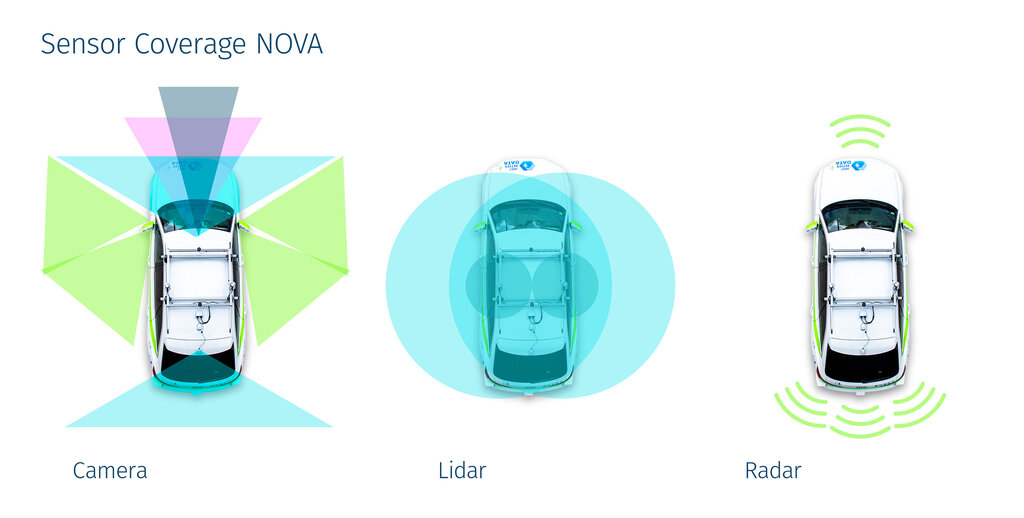
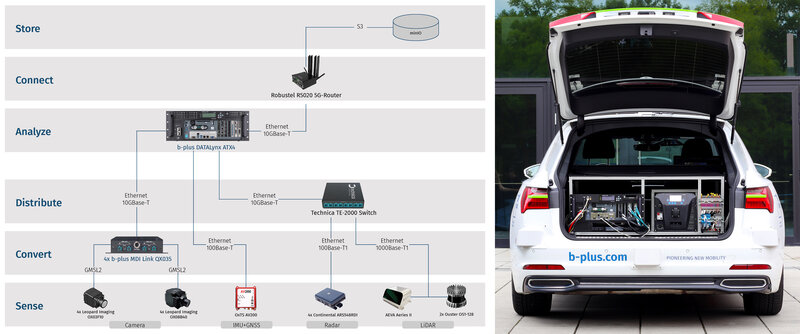
For b-plus, the focus was on developing the NOVA research vehicle. The platform was specifically designed to efficiently collect and process relevant data for the development and validation of autonomous driving functions. To this end, a multimodal sensor system comprising cameras, LiDAR, radar, GNSS, INS, and vehicle data sources was integrated. The various sensor technologies complement one another and enable the vehicle's surroundings to be monitored under a wide range of driving and weather conditions.
At the heart of NOVA is a powerful edge computing platform. The containerized, ROS2-based architecture enables AI applications to run directly in the vehicle. This allows sensor data to be analyzed, preprocessed, and evaluated in real time. The platform is complemented by a smart logging system that records data on an event-driven basis and stores only relevant scenarios.
Another contribution from b-plus was developed in collaboration with project partner Luxoft. As part of the project, a camera-based algorithm was developed and validated in NOVA that can determine the speed of two-wheeled vehicles, such as bicycles or e-scooters, using a single camera. This is achieved by combining modern object detection and multi-object tracking techniques to analyze movements in the image and calculate speeds in real time.
b-plus is also making the dataset collected as part of the project publicly available. The dataset was specifically developed for the validation of perception systems in rare and safety-critical traffic scenarios. By combining real sensor data with synthetically generated data, rare events and so-called “long-tail” scenarios can be better analyzed and evaluated. This provides a valuable foundation for robustness analyses, safety assessments, and the validation of modern AI-based perception systems.
“Better data is the key to the next generation of automated driving functions. With our NOVA research vehicle, we were able to test new approaches to intelligent data collection and selection. We are particularly pleased that the datasets generated during the project will be made available to the entire research community in the future and will thus have an impact far beyond the consortium.”
With jbDATA, the project partners are highlighting the importance of collaboration between industry, research institutions, and universities in the development of cutting-edge AI technologies. The resulting methods, tools, and datasets create an important foundation for the development of safe, reliable, and high-performance automated driving functions.
For more information, please visit our Applied Research website and the jbDATA project pages.
The dataset is now available for download.
Press Release Englisch (pdf)
Press Release English (Word)
Press Release German (pdf)
Press Release German (Word)
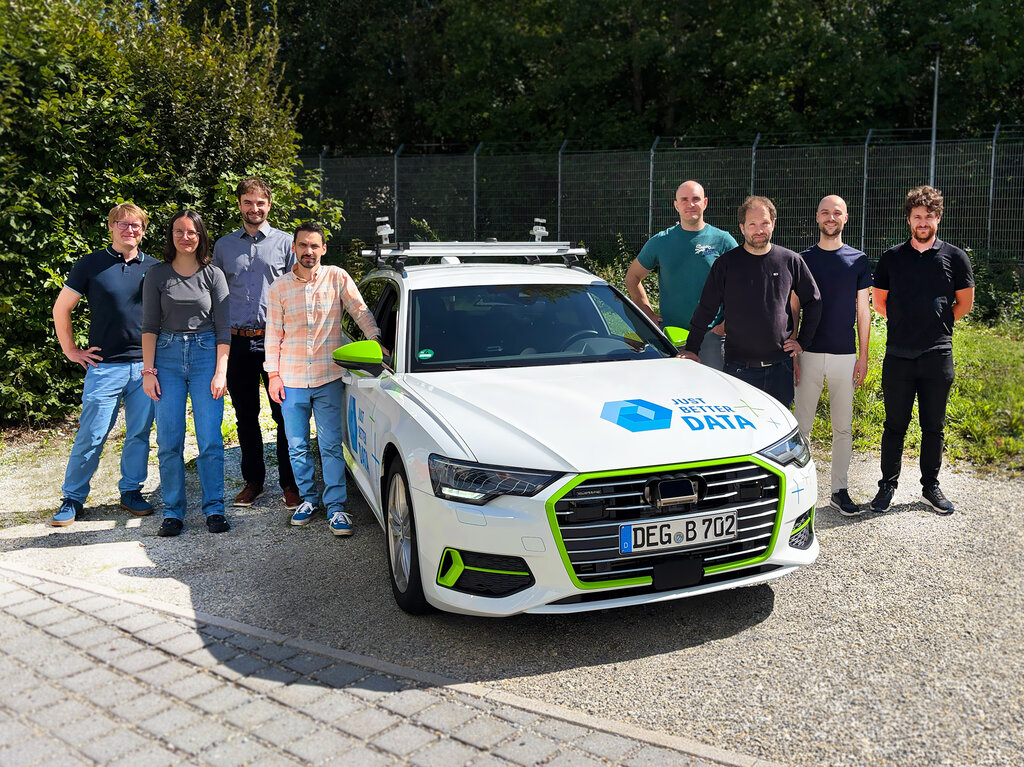
Image Team
Image Sensor Coverage
Image System Architecture