
With the new Recordings feature, b-plus brings greater transparency to large volumes of data and connects recordings with the information development and validation teams need for their daily work.
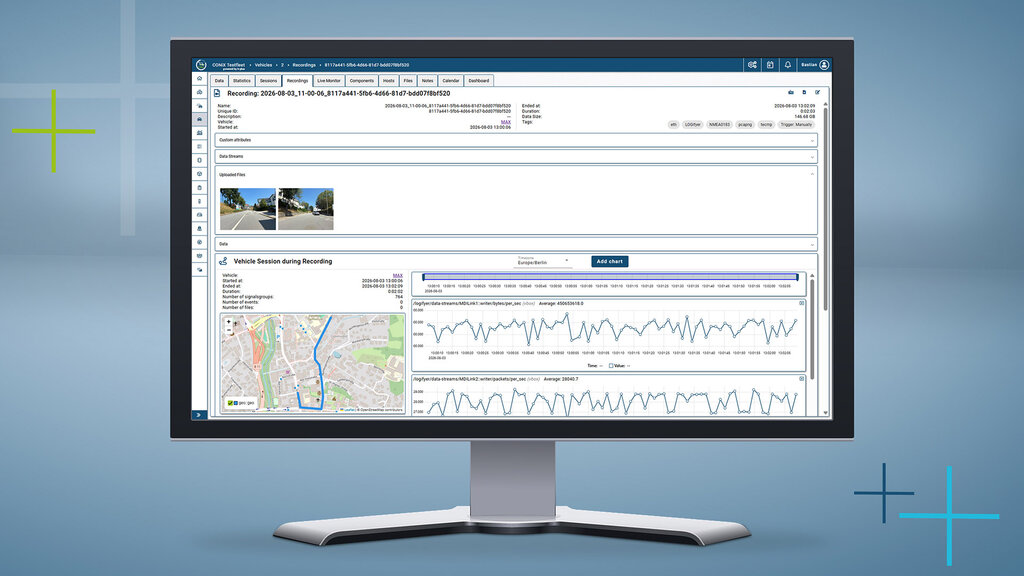
Deggendorf, 31 August 2026 – Modern vehicle testing generates enormous amounts of data. Individual recordings can quickly reach several hundred gigabytes or even several terabytes. But data volume is only part of the challenge. What really matters is being able to quickly understand which scenarios were recorded, under which conditions the data was generated and where the associated raw data is currently located. With the new Recordings feature in CONiX Testfleet 3.10, b-plus makes exactly this information centrally available.
Especially in ADAS and autonomous driving projects, development and validation teams need to search for specific scenarios – for example, recordings from a certain location, highway drives in rainy conditions or data from a defined vehicle and recorder setup. The larger the data pool becomes, the more important it is to access this information quickly without having to search through extensive raw data or compile the required context from different sources.
This is where Recordings comes in. Relevant information is captured during the test drive and transferred to the backend. This gives users an early and detailed overview of both ongoing and completed recordings. Even during the test operation, teams can see which data is being recorded and which vehicle and recorder setup is in use. Deviations from the intended setup can therefore be identified early and, if necessary, corrected while the test is still in progress.
For each recording, CONiX Testfleet provides a clear overview of key metadata, custom attributes and the included data streams. Images, configuration files and other project-related files can also be linked directly to a recording. Vehicle data from the respective recording period provides additional context on the location and conditions of the recording, making it easier to identify relevant scenarios within large data sets.
Additional transparency is provided through the connection to the CONiX Storage Tracking Feature. It shows whether the associated raw data is still located on a storage device in the vehicle, currently being transferred or already available in the cloud. This means users already know the content and context of a recording before the complete raw data has been uploaded – while also knowing where the data is currently located.
With releases 3.9 and 3.10, b-plus has significantly advanced CONiX Testfleet in two central areas. While version 3.9 primarily improved the way users work with driving data and its visualization, version 3.10 adds a structured view of the underlying recordings.
This further strengthens the existing connection between test operations, data and development work: important relationships become visible more quickly, additional relevant information is directly available and key workflows within the application become simpler and more intuitive.
For more information, please watch the video below and visit our website.

